
|
Love the World. |
Quick note: If you've been playing the same thoughts, conversations, or self-criticisms over and over, I hope you'll join me for Breaking Out of Rumination - early bird registration ends tomorrow.
To simplify and summarize, our brain has three primary motivational systems – Avoiding harm, Approaching rewards, and Attaching to “us” – that draw on many neural networks to accomplish their goals.
Lately, I’ve started to realize that a fourth fundamental human motivational system could be emerging as well.
Our hunter-gatherer ancestors depended upon their habitats for food and shelter. Today, over 8 billion of us are pressing hard up against the limits of Lifeboat Earth. To survive and to flourish, cultural and perhaps biological evolution is calling us to love the world.
The world is near to hand in the food you eat, the air you breathe, and the weather and climate in which you spend your days. And then in widening circles, the world extends out to include complex webs of life and the physical characteristics of the land, the sea, and the sky.
When you love the world, you both appreciate it and care for it. Each of these actions makes you feel good, plus they help you preserve and improve everything you depend on for your health, livelihood, security, pleasure, and community.
During most of the last several million years, our human and hominid ancestors did not have much capacity for harming the world. Nor did they have much understanding of their effects on the whole planet.
But now, humanity has great power for good and ill. And we have inescapable knowledge (no matter how much some try to deny it) of what we are doing to our own home. As the earth heats up, as many species go extinct, and as resources such as freshwater decline, it is critically important that a fourth major motivation guide our thoughts, words, and above all, deeds:
Love the world.
|
So, how do you do it? |
In terms of the aspect of love that is about appreciating, routinely look for opportunities to enjoy, value, and feel grateful for little things in the natural world.
These range from whatever is close by – flowers blooming, trees offering shade, honeybees moving from plant to plant – to the vast nest we all share, such as the exchanges of oxygen and CO2 through which animals and plants give breath to each other. We can also appreciate the fortuitous occurrence of a rocky planet – Earth – surviving the early formation of a solar system to find an orbit that allows for liquid water on its surface . . . and the even more remarkable occurrence of this universe bubbling into being: the largest nest of all, the extraordinary miracle in which we make our ordinary days.
In terms of the aspect of love that is about caring for, this means to me a combination of cherishing, protecting, and nurturing the world. You naturally cherish what you love; cherishing something, you want to keep it safe; once it’s protected, you want to help it flourish.
SO much could be written – and has – about cherishing our world, and protecting and nurturing it, yet I must be brief here, with just three suggestions.
For a minute, an hour, or a whole week, touch natural and human-made things around you like you truly cherish them.
Protect something from harm. You could save something you might otherwise throw away, from water running in a sink to food in a restaurant. More broadly, we can take political action to protect our world. Different people will find different paths with this. Personally, I’ve been inspired by young people – who will most inherit the consequences of the 100 million tons of CO2 their parents have been pouring up into the sky each day – who are saying enough is enough.
Pick one thing and focus on helping it grow and thrive. Perhaps a plant, or a business, or a project at a local school, or a collaboration among some friends, or a fix-it repair at home.
At the heart of it, this practice is about our relationship with the world. Do we relate to it as an adversary or a distant acquaintance?
Or do we relate to the world as a friend, a child, a beloved nest?
Here and there and everywhere, let’s all live in a world we love.
|
| Read This Online
|
Share on Facebook | Forward this Email
|
|
|
|
|
|
MORE GOOD STUFF
|

|
Feeling overwhelmed by life or the state of the world? You’re not alone. So many of us are carrying more stress, uncertainty, and mental load right now, and it can be hard to stay grounded, steady, and strong through it all. That’s why I'm joining the folks at Mindfulness.com for The Seven Strengths: a free live 7-day course to help you build the inner skills that support lasting resilience, peace, and mental wellbeing.
Check it out here
|
|
|
How to Claim the Power You Do Have (and Disengage Where You Don’t)
We often give away our power by focusing on what we can’t control and getting pulled into stress, overthinking, or other people’s reactions. This week I focused on how to reclaim your power by focusing on where you actually have influence—your attention, your actions, and your choices—so you can live with more clarity, strength, and purpose.
Check it out here | Join the Wednesday Talks for Free
|
|
|
SCIENCE NEWS: Are Baby Rattlesnakes More Dangerous than Adults?
A new study gently cuts through a familiar fear: baby rattlesnakes are not deadlier than adults, and the real danger usually grows with the snake’s size.
(View the Science News Archive)
|
|
|
FOR PARENTS: “Green” Parenting Tips
Helping kids care for the earth is really about helping them care for life. Small everyday habits can grow into a deep sense of responsibility, connection, and hope.
|
|
|
|
|
|
NEW ON THE PODCAST
|
Why You Can’t Stop Overthinking (and What to Do about It) |
EPISODE 469:
Dr. Rick and Forrest discuss why rumination becomes a self-reinforcing habit, and why insight alone rarely helps.
|
> Listen Now
|
|
|
|
|
|
NEW BOOK AVAILABLE FOR PREORDER
|
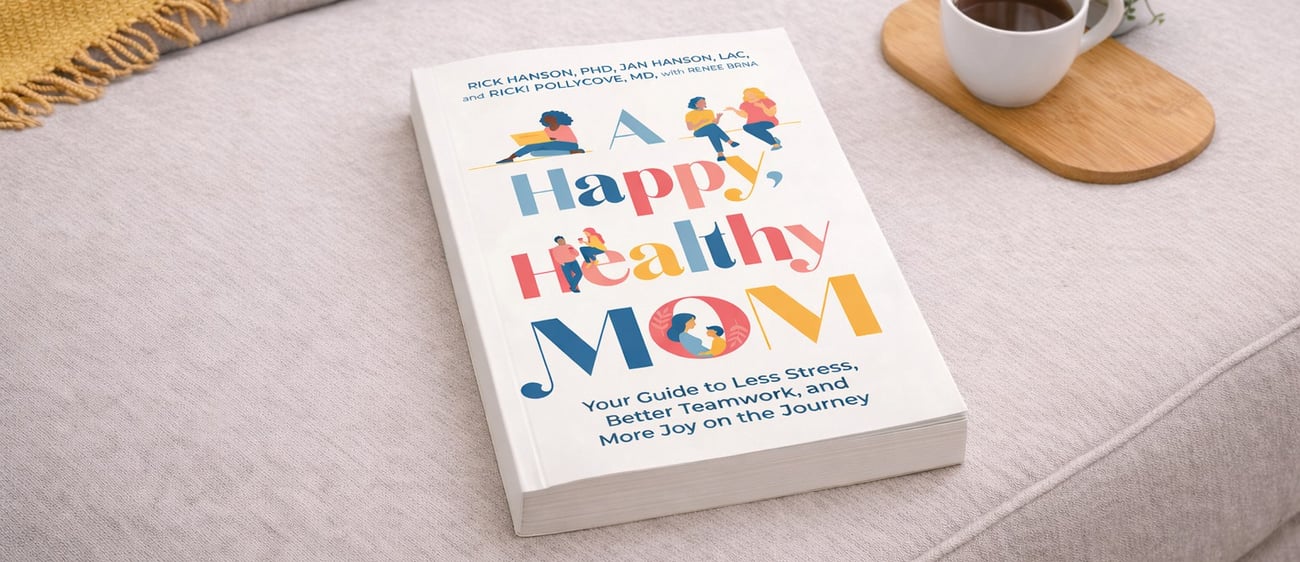
A Happy, Healthy Mom |
|
We wrote this book for moms who feel exhausted, overwhelmed, or stretched too thin during the early years of raising a child. My wife Jan (a nutrition expert), friend Ricki Pollycove (a gynecologist-obstetrician), and I hope this will help moms reconnect to their own needs, restore their energy, reduce stress, and feel more supported — physically and emotionally. If you're a mom - or know one who could use some more support, I hope you'll check it out!
|
| Preorder Your Copy
|
|
|
|
JUST ONE THING (JOT) suggests a simple practice each week for more joy, more fulfilling relationships, and more peace of mind. A small thing repeated routinely adds up over time to produce big results.
Just one thing that could change your life.
(© Rick Hanson, 2026)
|
|
|
|
|
|
|
|
|


