
|
Accept It. |
Quick note: If you've been struggling with looping, negative thoughts, I hope you'll join me for Breaking Out of Rumination - sign up by tomorrow to save 25%.
As general clusters that each include a number of specific methods, my Top 5 types of practices (all tied for first place) are:
- Be mindful
- Love
- Take in the good
- Go green
- Open out
The practice of “go green” helps you get out of the brain’s fight-or-flight, Reactive, “red zone” setting and instead, engage life from its recover-and-refuel, Responsive, “green zone” setting.
In this JOT, we’ll enter into the fifth cluster - open out - by which I mean relaxing into a growing sense of connection, even oneness, with all things. For some, “opening out” could go all the way out to something transcendental (it does for me). But I’m going to write about this practice in very down-to-earth, practical, and psychological terms.
The opposite of opening out is contraction, and a primary source of contraction is not accepting the way it is. Much if not most of our stress, emotional pain, and conflicts with others comes from friction, from resistance to life as it is.
Acceptance means you give up on the truth - the facts, reality - no matter what it is. You may not like it, which is usually understandable. For example, I don't like the fact that one in five children in America lives below the poverty line, or that my mother is no longer here, or that I've hurt people by losing my temper. But things are the way they are, and we can accept them while still trying to make them better (when that's possible).
At the bottom, acceptance grounds you in what is true, which is where you have to start for any true effectiveness, happiness, or healing. Acceptance is the foundation of wisdom and inner peace.
|
So, how do you do it? |
Recognize what you are not accepting. Common things include: the body changing with age, upsets with others that aren't healing, past failures, not having enough money, or your temperament or abilities. Some losses are irrevocable; that person, that moment, that opportunity is never coming back. Perhaps you turned a corner - in your youth, or recently - and now you wish you'd turned the other way.
To make this concrete, pick one thing that you strongly wish were different. Say it in your mind as a factual statement without any sugar-coating. (You can also do this in writing.) For example, you might say something like: "I've lost my friendship with Mary . . . our son's struggle with school is not getting better . . . it looks like I have cancer . . . my marriage feels empty . . . this boss will never promote me . . . I will eventually die . . . I did mistreat Bob . . . I will never have a child of my own . . . Carlo won't engage me in repairing our relationship . . . "
Then see what it's like to hold this fact in a context of acceptance (while knowing that you could also try to make things better if that's possible). Fill in the blank with the fact, and say things to yourself like: "It's true that ______ . . . I see that ______ . . . I surrender to the fact that ______ . . . I wish with all my heart that ______ weren't the case, but it is . . . I give up about ______ . . . " See if you can soften around the truth of things if you can open out to the way it is. A variation of this is to imagine someone (or group of people) who loves you, who is looking at you with great kindness and respect while saying the things in this paragraph.
Often what blocks you from accepting a condition - something that is true about the world, your body, or your mind - is what you'd experience if you accepted the condition. To accept the experience, try to step back and witness it; open to it in your body; if it's very painful, touch it and let it go. Take your time, take breaks if you need to. Resource yourself to open to your experience. For example, calm and soothe yourself; brings to mind the sense of others who love you; have self-compassion.
Notice ways you don't accept things. Any kind of anger or righteousness is usually a clue. You can be discerning, persuasive, or consequential regarding someone without tipping into struggling with him or her. Consider lowering your standards for others while raising them for yourself. I don't mean being more critical of yourself - a kind of non-acceptance - but rather being less critical of others and more focused on raising your own level of well-being and functioning.
Another form of resistance, of non-acceptance, is continuing to try to make something happen that just ain't gonna happen. Obviously, we don't want to give up too soon. Nonetheless, while it may be sad, even awful to face the truth, sometimes the love we long for will not come, a business will not succeed, or a course of medical treatment will not work. Be aware of how your strengths can become a weakness at acceptance; for example, I have a lot of drive, which has sometimes kept me searching way too long inside tunnels that truly have no cheese.
It's easy to accept beautiful sunsets, golden prizes, and cotton candy. It's the hard things that are hard to accept. So it's important to appreciate the peace that comes from giving up the fight with the way it is. You do what you can - which is sometimes nothing at all - while also being very real with yourself about what is actually true. This usually eases conflicts with others. At some point, an easing comes into your heart, a softening and a clarity. And hard-won, honest freedom.
|
| Read This Online
|
Share on Facebook | Forward this Email
|
|
|
|
|
|
MORE GOOD STUFF
|

|
I'm proud to be one of the featured speakers in the FREE Healing Your Deepest Wounds event, taking place online May 12–18. Over 7 days, you’ll discover powerful, science-informed frameworks to help you make sense of past experiences, restore nervous system safety, and cultivate greater clarity, self-trust, emotional resilience, and grounded change in your relationships and daily life.
Check it out here
|
|
|
When Unjust Power Comes at You – and What You Can Do about It
When power comes at us — through authority, intimidation, manipulation, or fear — it can stir old anxiety and self-doubt. So this week I explored how power affects the mind, from personal relationships and childhood conditioning to social hierarchies and authoritarian appeals. We took a look at how greed, hatred, and delusion can corrupt power, how to recognize manipulation and intimidation, and how to reclaim your attention instead of letting fear run the show.
Check it out here | Join the Wednesday Talks for Free
|
|
|
SCIENCE NEWS: A Whale of a Swim Lesson
Scientists recently witnessed a rare and intimate moment in the open ocean: the birth of a sperm whale, captured in remarkable detail. In this incredible video, we see not only new life emerging, but the quiet, intricate bonds that shape how these deep-diving beings care for one another and move through their shared world.
(View the Science News Archive)
|
|
|
FOR PARENTS: Speaking from Your Heart
How can you help yourself communicate authentically and skillfully – so that the outside you show the world more closely matches your insides? Think of these questions as a kind of checklist; you may have most of them covered already, but there could also be some helpful suggestions.
|
|
|
|
|
|
NEW ON THE PODCAST
|
Mentalization-Based Therapy for Borderline Personality Disorder with Robert Drozek
|
EPISODE 470:
Forrest is joined by psychotherapist and author Robert Drozek to discuss mentalization-based treatment (MBT) and the tools that can help us develop more flexibility and curiosity around our assumptions.
|
> Listen Now
|
|
|
|
|
|
NEW BOOK AVAILABLE FOR PREORDER
|
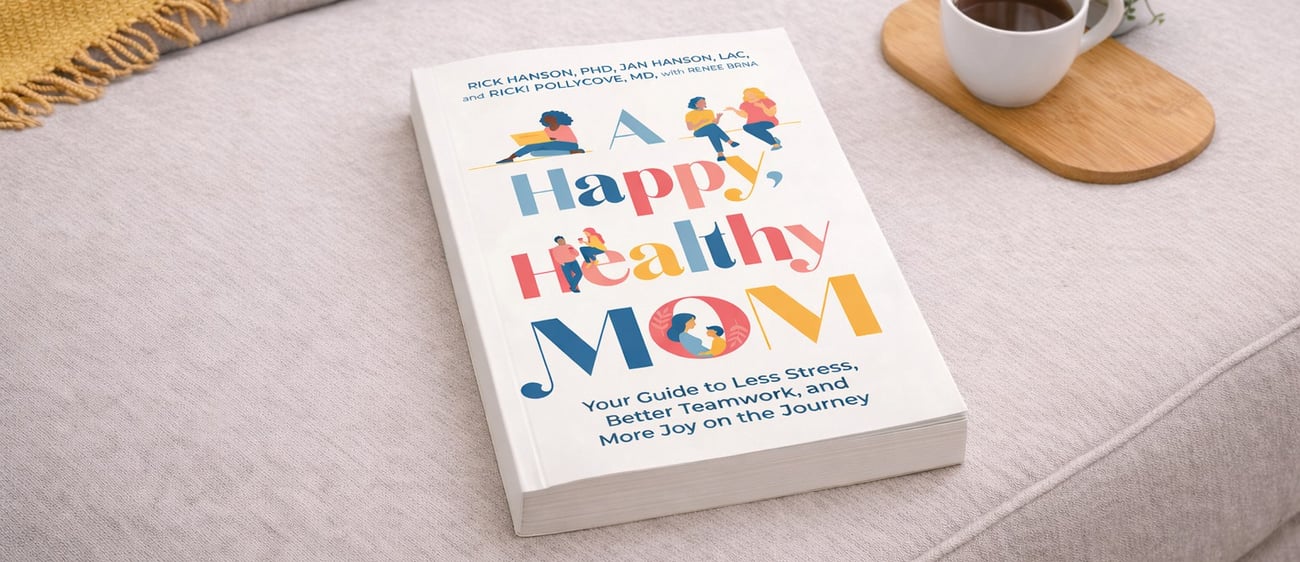
A Happy, Healthy Mom |
|
We wrote this book for moms who feel exhausted, overwhelmed, or stretched too thin during the early years of raising a child. My wife Jan (a nutrition expert), friend Ricki Pollycove (a gynecologist-obstetrician), and I hope this will help moms reconnect to their own needs, restore their energy, reduce stress, and feel more supported — physically and emotionally. If you're a mom - or know one who could use some more support, I hope you'll check it out!
|
| Preorder Your Copy
|
|
|
|
JUST ONE THING (JOT) suggests a simple practice each week for more joy, more fulfilling relationships, and more peace of mind. A small thing repeated routinely adds up over time to produce big results.
Just one thing that could change your life.
(© Rick Hanson, 2026)
|
|
|
|
|
|
|
|
|


