Drop the Load. |
Quick note: If you've been stuck in negative thoughts and patterns, I hope you'll check out my Change Your Mind course that starts this Saturday. |
|
You may have seen the old Mickey Mouse movie in which he is working at a conveyor belt in a factory. More and more widgets come at him that he must handle, and he gets increasingly frazzled as he struggles to keep up.
Do you ever feel the same way? Think about all the dishes, emails, meetings, reports, drives, calls returned, laundry folded, children tucked into bed, friends comforted, errands run, etc., etc. Most of a person’s tasks, even all of them, could be individually rewarding and done for a good purpose, but taken as a whole they’re often too much. It’s certainly gotten this way for me.
Doing crowds out being, the urgent crowds out the important, and you go to bed after working hard all day feeling frustrated and maybe self-critical that you didn’t get more done. Meanwhile, the stress chemistry of your body has gotten jacked up since hurrying, multi-tasking, and feeling pressured trigger essentially the same hormonal and neural mechanisms that helped our ancestors run away from charging lions. At the heart of it all, there’s an unfreedom: you can feel chained to obligatory tasks.
What to do? |
So, how do you do it? |
|
Of course, it’s good to make an effort, to hold up your end of the log. You honor your previous commitments. And sometimes new things come your way - some wonderful, some not - that do require a lot of work, like having children, finishing college, starting a business, or getting through an unexpected and serious illness.
But when you can - and this has become very important for me lately - be careful about adding new, discretionary items into the commitments hopper. Give yourself time to think. Be really really clear about all the little things that will come with this additional obligation, including new things you’ll have to think about or take time doing. Are the rewards of the new commitment really worth these costs?
Don’t be hypnotized by the rewards of the new thing. Wisdom is choosing greater happiness over a lesser one. Sometimes you have to give up the lesser rewards of the new thing for the greater rewards of allowing some new space to clear in your life.
Put a Fence around Doing
As a young man, I worked briefly in a factory loading cases of soft drinks onto pallets for trucks. It was hard physical labor, but at the end of the shift when we clocked out it was definitively over - what a relief. Similarly, set a time each day when you are truly done: no more emails, no more housework, no more projects. You made an effort today, you did what you could, and now you’re clocked out.
A related way to approach this is in terms of the saying, “first put the big rocks in your bucket.” In other words, make time commitments to what you value more that will push what you value less to the margins. If you value exercise, commit to a class at the gym or reschedule dinner to give you time for a run when you get home from work. If you value meditation or prayer in the morning, get to bed half an hour sooner so you can get up half an hour earlier to do your practice. Imagine looking back on your life: will you care that you got all those To Do’s done or care that you did the things that mattered most to you?
Shift Your Relationship to Tasks
Getting stuff done sometimes seems like the secular religion of the developed world, especially in America, where we routinely make sacrifices at the altar of doingness. I’m this way myself: my main compulsion/addiction is crossing off items on my To-Do list. Instead, try to see task-doing in a freer and more disenchanted way.
Watch your mind and its sense of “must” when it comes to tasks. Keep returning to the feeling that you are choosing to do the task, not driven to it. Remind yourself - when it’s true - that you actually don’t have to do a particular task. Try to calm down any sense of drivenness or urgency. Slow down a little. Try to do tasks from the “green zone” in which you experience that your fundamental needs for safety, satisfaction, and connection are already basically being met.
See the ways that your attention narrows down on the next thing to do and the one after that. Try to stay aware of the big picture, that things as a whole are fine, that this particular task in front of you is just a tiny tile in a huge mosaic. It’s not worth getting tense or intense about.
When you do finish a task, take a moment to register it. Let an appropriate sense of completion and satisfaction land before rushing on to the next thing. Keep in mind the ways that a mundane task is linked to larger things. Changing a diaper is linked to loving and protecting a child; driving to work is linked to providing for oneself and others.
Recognize That Tasks Are “Empty”
And, if it’s meaningful to you, you can try something I’ve been exploring lately. Be aware of the experience of doing a task - the sights and sounds and emotions while washing dishes say - and then notice how the experience is made up of many parts that constantly change and blend into each other. While the plate in your hand is substantial - you can hold onto it - your experience of the plate is not: the sensations and images of the plate are insubstantial; you can’t hold onto them. Your experience of the plate – and everything else, too – is “empty” of independent substantiality.
When you look at task-doing this way - not so much as things happening “out there” but as experiences happening “in here” - and you can see the multi-part, fleeting, insubstantial, and “empty” nature of these experiences, something shifts. You feel freer inside, less bound to tasks, and more relaxed and open. When seen as empty – not meaningless and not nonexistent, but insubstantial and ephemeral - the anticipated pleasures of getting stuff done aren’t as compelling and the anticipated pains of not doing aren’t as worrisome. You still get a lot done, but in a more peaceful way. |
| Read This Online |
|
Share on Facebook | Forward this Email |
|
|
|
|
|
|
MORE GOOD STUFF |
|
|
How to Feel That You’ve Done Enough – and Are Enough
Many of us spend our lives quietly believing we need to do more, achieve more, or become more before we can finally feel at peace. What if the peace you’ve been searching for doesn’t come from becoming more—but from recognizing that, in important ways, you’re already enough? In this talk, I explore how the mind gets caught in endless striving and comparison, and how we can gently train ourselves to rest in gladness, contentment, and the deep sense that we’ve done enough, are enough, and that this moment can be enough too.
Check it out here | Join the Wednesday Talks for Free
|
|
|
FREE SUMMIT: My Life Reimagined
I'm proud to be a part of the FREE My Life Reimagined Summit, taking place online August 11 - 15, 2026. It’s a 5-day event where you'll discover how imagination shapes your reality and how expanding your imagination can help you unlock new possibilities for healing, creativity, connection, purpose, and transformation.
Sign up FREE
|
|
|
FROM SUBSTACK: Am I Overthinking or Dysregulated?
When you’re caught in a mental loop, replaying conversations, analyzing decisions, spiraling through worst-case scenarios, it’s natural to assume you need to think your way through it.
But here’s what I want you to understand: When you’re dysregulated, your thinking is compromised. You literally can’t access clear reasoning when your nervous system is activated.
The first question isn’t “What should I think about this?”
The first question is: “Am I regulated right now?”
Read more | Subscribe to My Substack
|
|
|
SCIENCE NEWS: How Discarded Plastic Bottles Are Saving Dolphins
Scientists have recently found that attaching empty plastic bottles to fishing nets can help dolphins avoid getting caught, cutting dolphin deaths by about 88% without reducing the fish catch
(View the Science News Archive)
|
|
|
FOR PARENTS: Turn Anger into a Peaceful Heart
Let’s be realistic: it’s completely normal for a mother to get angry with her children. Or with her partner, the in-laws, her clueless boss—or herself. Studies have found that the more children a woman has, the more time she spends with them or doing housework, or the more hassles she has with child care or her kids, the angrier she’s likely to be. There’s no need to feel guilty about anger itself. The real question is, what can you do about it?
|
|
|
|
|
|
|
NEW BOOK AVAILABLE FOR PREORDER |
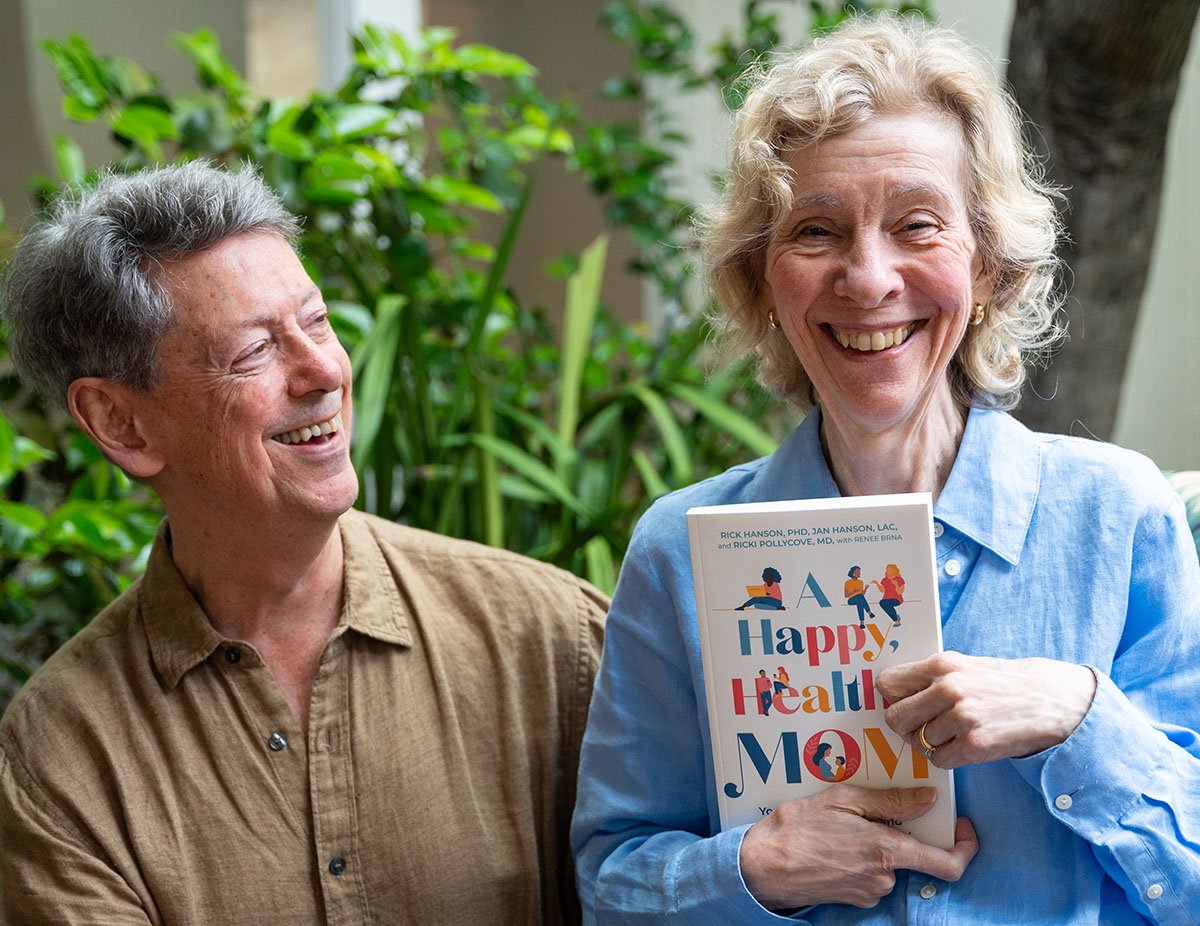
A Happy, Healthy Mom |
 |
|
We wrote this book for moms who feel exhausted, overwhelmed, or stretched too thin during the early years of raising a child. My wife Jan (a nutrition expert), friend Ricki Pollycove (a gynecologist-obstetrician), and I hope this will help moms reconnect to their own needs, restore their energy, reduce stress, and feel more supported — physically and emotionally. If you're a mom - or know one who could use some more support, I hope you'll check it out!
|
| Preorder Your Copy |
|
|
|
|
|
|
NEW ON THE PODCAST |
|
|
|
EPISODE 484:
Dr. Rick and Forrest explore burnout: what it is, why it’s so common, and what people can do about it. |
|
> Listen Now |
|
|
|
|
JUST ONE THING (JOT) suggests a simple practice each week for more joy, more fulfilling relationships, and more peace of mind. A small thing repeated routinely adds up over time to produce big results.
Just one thing that could change your life.
(© Rick Hanson, 2026) |
|
|
|
|
|
|
|
|