|
If you're still struggling with old wounds and ready to heal them in a lasting way, I hope you'll join me for The Healing Link which starts October 16th. You'll join me live on Zoom every week for 6 weeks and we'lll focus on filling up the empty places inside so you can feel more secure, worthy, and joyful. (Sign up by Friday to get the early-bird half-off pricing!) |
|
|
|
|
|
|
“Tell the truth.” It’s the foundation of science – and the foundation of healthy relationships, communities, and countries.
But the truth of things is complicated. To simplify, there is the good of things that are enjoyable and helpful, the bad of things that are painful and harmful, and the neutral of things that are neither.
We need to recognize genuinely bad news for our own sake and to take care of others. But we also need to recognize good news: things that are useful, reassuring, inspiring, opportunities, solutions, etc.
The Brain’s Negativity Bias
Unfortunately, we have a brain that generally fixates on bad news and brushes past good news. Over the 600 hundred million year evolution of the nervous system, our ancestors:
- Had to avoid two kinds of mistakes: (1) thinking that there’s a tiger in the bushes but actually all is well, or (2) thinking that all is well while actually there is a tiger about to pounce. What’s the cost of the first mistake? Just needless worry. But what’s the potential cost of the second mistake? No more mistakes . . . forever. So we have a brain that tends to make the first mistake, again and again, to avoid ever making the second one.
- Had to get “carrots” such as food and avoid “sticks” such as predators. Imagine living back in the Stone Age – or even Jurassic Park. If you didn’t get a carrot today, you’d have another chance tomorrow. But if you didn’t avoid every single stick today, game over. Consequently, negative experiences are fast-tracked into memory - “once burned, twice shy” - while most positive experiences slip through the brain like water through a sieve. In effect, the brain is like Velcro for negative experiences but Teflon for positive ones.
As a result, we routinely overestimate threats while underestimating opportunities and resources. Some people have an “optimism bias” in what they say. But in their actions, studies show that most people work harder to avoid pain than to get pleasure and remember failures and rejections more than successes and kindness from others. One result is that the media focuses on bad news because that’s what people pay attention to; thus, the saying in journalism is, “if it bleeds, it leads.”
Living in a Bad Dream
It’s as if we live in a subtle nightmare in which the shadows and threats are close and intense while our resources and opportunities seem distant and weak. We think the dream is real, so there’s no point in trying to wake up from it. Our beliefs in the dream trap us like the bars of an invisible cage.
As many have taught, I believe that the root cause of suffering and harm is ignorance, illusion, not seeing things as they actually are. So when we wake up and see the facts and live in the light, we feel much freer, more at ease, clearer about genuine threats, and more confident about dealing with them.
Waking up and Seeing Clearly
Remember a time in your past when you realized that things were not as bad as you thought. How did it feel to wake up in this way?
For instance, I recognized in my twenties that I'd been a real nerd – but definitely not a wimp as a kid. This was a huge relief for me.
In other examples, I’ve known people who came to see that:
- they could be strong, and others would still like them
- have fun without being buzzed with drugs or alcohol
- most other people did not care about their appearance
- there’s often less standing in the way of our dreams than we think
Yes, sometimes when we wake up, it’s to bad news that we had not recognized. Perhaps you realize that you’ve hit a ceiling in your job, or you’ve been too cranky with your kids, or a friend is not trustworthy in an important way.
Living in the truth means seeing both good and bad clearly.
But because of the brain’s evolved negativity bias, most of the time when we wake up, it’s to truly good news. |
So, how do you do it? |
|
Recognize Bad News
To repeat, nothing I’m saying here is about positive thinking, looking on the bright side, or seeing through rose-colored glasses. We need to see real threats, real problems, at all levels. For example, as an individual, I’ve needed to see that I have to slow down some as I get older. A couple may need to see that it has to stop getting so caught up in circular arguments. Humanity altogether needs to recognize that dumping 100 million tons a day of carbon dioxide into the air is already having devastating effects that will only get worse for our children and theirs.
And – to deal with actually bad news, it really helps to recognize the good news that is also true. This puts challenges in perspective, highlights resources, and evokes the positive experiences that are the main basis for growing inner strengths such as grit, gratitude, and compassion.
Recognize When There’s No Tiger in the Bushes – Or That You Can Deal with It
Consider your fears. Especially the everyday ones, such as:
- If I say how I really feel, people will hurt me or leave me.
- If I ask for a raise, I’ll lose my job.
- If I look for a partner, no one will want me.
How many of these fears are actually true? Here are three really important questions: What are the odds of them happening? If they indeed happened, how bad would it really feel? And if the unlikely event did happen and if it felt really bad, how would you cope?
Think about the many things that protect and support you, from locks to laws, friends to health insurance. (Again, this is about seeing clearly, not about overestimating the resources in your life.) In particular, think about the inner strengths that you’ve used for tough times in the past and which you could draw upon to deal with challenges today.
Recognize Opportunities
What have you always wanted to do – but told yourself is out of reach?
Ask yourself what would happen if you invested just 20 minutes a day in meditation, or in exercise, or in supportive conversation with a friend or partner – or what would happen if you invested just an hour a day in all three.
What would happen if you spent half an hour a day on some project, such as writing a book, laying the groundwork for changing careers, learning a musical instrument, or making art – and could these hours add up over a single year?
Recognize Good News About Yourself
Consider some of the many ways you have been seen, included, appreciated, liked, or loved.
Think about the people who have seen the real you – and still cared about you. Can you see yourself as another person might . . . and recognize the good heart in you, the sincere efforts, the longing for a just world, the talents and skills, the intuitions and imagination, and the innate natural goodness and wisdom inside you – and everyone else?
When we look around, things can seem overwhelming, especially at the level of society and its politics. It’s easy to get lost in helpless outrage. Few of us have the power to make sweeping changes in a country – but all of us have the power to do something each day that makes life a little better for those around us. And gradually, these efforts ripple out in widening circles, in ways seen and unseen, to touch the whole world.
Looking back over the sweep of human history, the good that has gradually developed is mainly the result of the slowly accumulating efforts of countless unnamed people. We are not helpless in our own lives! The words we speak, the attention we offer, the votes we cast, the hands we hold, the dreams we honor . . . these all matter. They matter to others, and they matter to oneself: knowing that you have done what you could in the one life you have. The effort itself is good and knowing you have made it is deeply good news.
I love these last lines in Dylan Thomas’s poem, Fern Hill:
Time held me green and dying
Though I sang in my chains like the sea. |
| Read This Online |
|
Share on Facebook | Forward this Email |
|
|
|
|
|
|
MORE GOOD STUFF |
|
|
|
Strength with Heart Course
Starting October 3, Strength with Heart is an online training for men from Spirit Rock Meditation Center, led by Daniel Ellenberg, Ph.D., James Baraz, and Keith Martin-Smith.
The program brings together contemplative practice, depth psychology, somatic work, and relational practice, giving participants a sustained way to explore strength, connection, courage, care, and leadership in the context of everyday life. Use Code Beingwell10 to save 10%.
Check it out here
|
|
|
FROM SUBSTACK:
What Am I Really Bottling Up?
Think about a significant relationship, a friend, a family member, a spouse, a parent, a child, a coworker, a neighbour.
Have you been able to talk about things with this person?
Have you been able to express it if you didn’t like how something went?
Or, on the other hand, have you been able to express some of the warm feelings you might have for them? Appreciation and respect, affection, even love. It’s not just negative reactions to other people that get bottled up.
Read more | Subscribe to My Substack
|
|
|
TALK: Expanding Compassion
for Our Times
In this talk recently hosted by the Center for Mindfulness and Compassion at Harvard Medical School, I explored how compassion can expand beyond empathy for those who are like us and considered a bolder, “fierce” compassion - one that includes people we may dislike or oppose, responds to suffering with courage and clarity, and addresses not only its immediate effects but also its deeper systemic causes. I really hope you'll check it out!
Check it out here |
|
|
SCIENCE NEWS: New Sea Spiders Turn Up Off Canada’s Coast
Scientists have found two tiny new sea-spider species in the shallow Salish Sea, which is an encouraging reminder that even well-studied coastlines still hold surprising forms of life.
(View the Science News Archive) |
|
|
FOR PARENTS: Getting More Sleep
Loss of sleep is a major reason why many parents of young children feel depleted; besides wearing you out, sleep deprivation robs the brain of certain substances you need for health and well-being. Here are a few suggestions.
|
|
|
|
|
|
|
NOW AVAILABLE TO PURCHASE! |
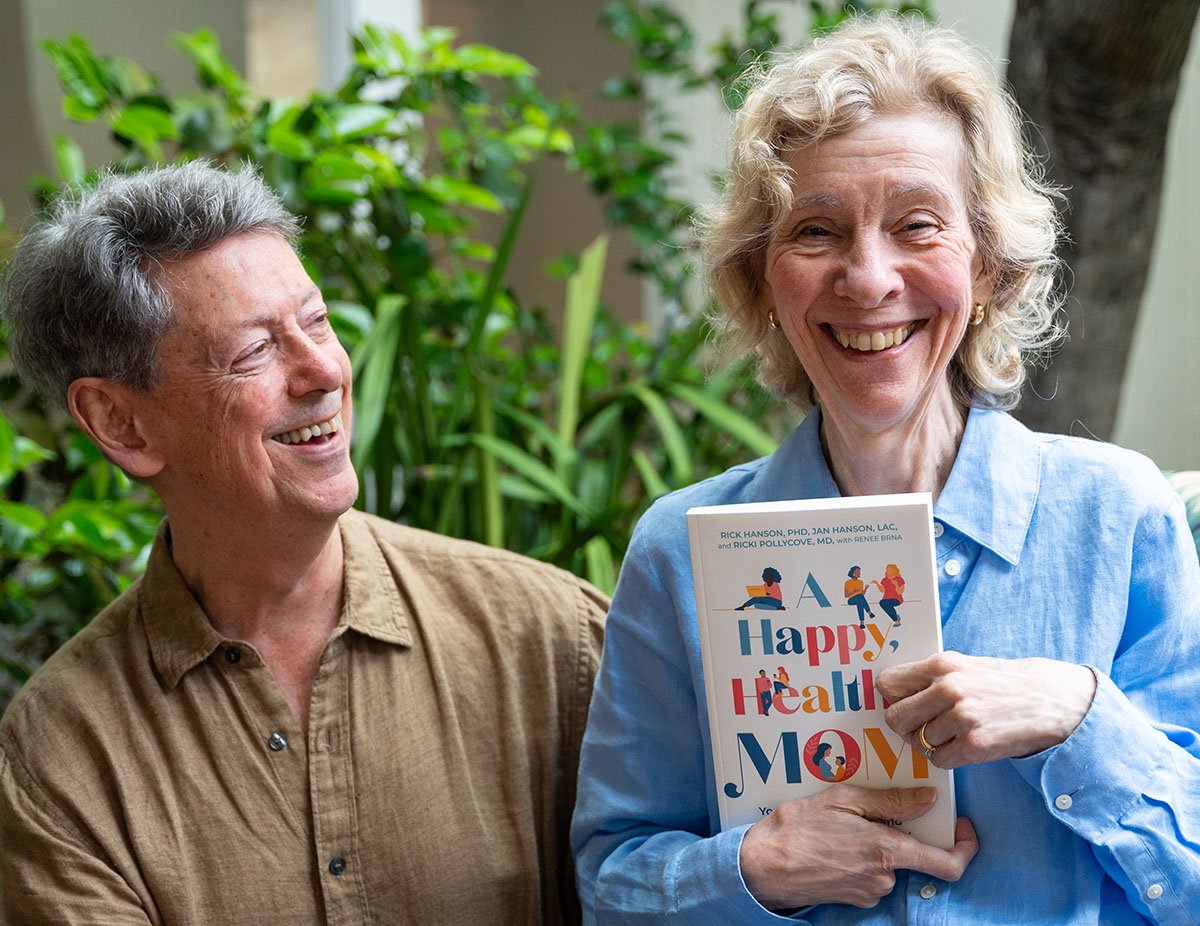
A Happy, Healthy Mom |
 |
|
We wrote this book for moms who feel exhausted, overwhelmed, or stretched too thin during the early years of raising a child. My wife Jan (a nutrition expert), friend Ricki Pollycove (a gynecologist-obstetrician), and I hope this will help moms reconnect to their own needs, restore their energy, reduce stress, and feel more supported — physically and emotionally. If you're a mom - or know one who could use some more support, I hope you'll check it out!
|
| Get Your Copy |
|
|
|
|
|
|
NEW ON THE PODCAST |
|
|
|
EPISODE 491:
Shame is one of the hardest emotions to work with, in part because it blocks what we need most when we’re feeling shame: self-compassion. Dr. Chris Germer, co-developer of the Mindful Self-Compassion program, joins Forrest to discuss how we can get around that trap and begin treating shame with self-compassion. They talk about where shame comes from, how to recognize it when it’s hiding behind other emotions, and practical tools that help us experience less shame. |
|
> Listen Now |
|
|
|
|
JUST ONE THING (JOT) suggests a simple practice each week for more joy, more fulfilling relationships, and more peace of mind. A small thing repeated routinely adds up over time to produce big results.
Just one thing that could change your life.
(© Rick Hanson, 2026) |
|
|
|
|
|
|
|
|