|
I've just opened registration for a brand-new course that will be LIVE over 6 weeks. It's called The Healing Link and it focuses on reaching the wounded, younger layers inside you to heal old pain - for good. You'll join me live on Zoom every week for a teaching, practice, and Q&A, and you'll get daily practices, access to live practice groups, and more. (Sign up soon to get the early-bird half-off pricing!) |
|
|
|
|
|
|
Many years ago, I was in a significant relationship in which the other person started doing things that surprised and hurt me. I'll preserve the privacy here so I won't be concrete, but it was pretty intense. After going through the first wave of reactions - What?! How could you? Are you kidding me?! - I settled down a bit. I had a choice.
This relationship was important to me, and I could see that a lot of what was going through the mind over there was really about the other person and not about me. I began to realize that the freest, strongest, and the most self-respecting thing that I could do was both to tell the person that we were on very thin ice . . . and to choose to love meanwhile.
To my surprise, instead of turning me into a doormat or punching bag, love protected and fueled me. It kept me out of contentiousness and conflict and gave me a feeling of worth. I was interested in what the other person was going to do, but in a weird way, I didn't care that much. I felt fed and carried by love, and how the other person responded was out of my hands.
I got interested in "loving at will," in how to go to the upper end of the range of what is authentically available to a person in terms of feeling or expressing compassion, good wishes, and warmth. You shouldn't falsify what's truly going on with you, nor let yourself be mistreated. But whatever this range is for you at any moment in any relationship, it's your choice where you land within it.
I became less caught up in how I wanted the other person to think and feel and act, and more focused on my own practice of finding and re-finding some sense of love. It felt kind of like I was strengthening the heart like a muscle. I joked with myself that I was doing love pushups (not the sexual kind!).
If it's authentically within reach, you can deliberately, even willfully settle yourself in love as a central quality in your mind. This is not phony: the love that's there in you is genuinely there. In fact, choosing to love is twice loving: it's a loving act to call up the intention to love, plus there is the love that follows.
Looking back, my shift out of quarreling and into a healthy feeling of lovingness helped things get better with this person. And the relationship taught me a good lesson:
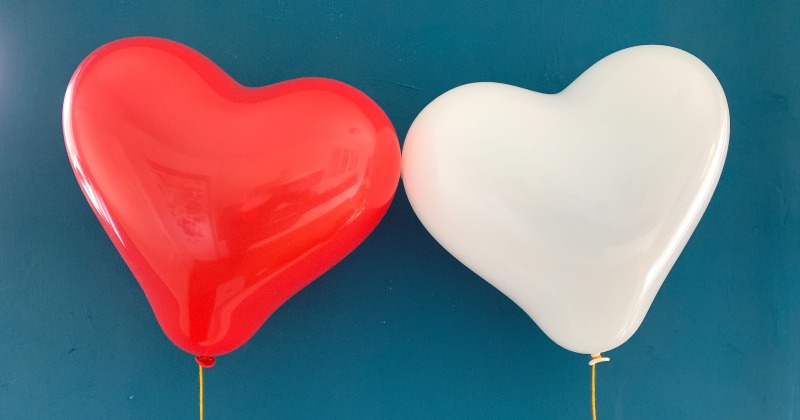
Love is more about us being loving than about other people being lovable. |
So, how do you do it? |
|
Start with someone that's easy to feel love around. Relax a bit. Take a breath or two and come home to yourself. Sense into the area of your chest and heart. Be aware of what compassion and kindness feel like; perhaps call up the sense of a time when you felt very loving. Ask yourself, Can I feel loving now? Open to a natural warm-heartedness. Choose to love.
Take a dozen seconds to open to feeling as loving as you can in your body. Take in this experience, let it sink into you. This will strengthen the neural trace of the experience - a kind of emotional memory - and make it easier to call up the next time. Also register the sense of deliberateness, of choosing to love.
Then try these methods with someone you feel more neutral about, such as a stranger on the street. Eventually, try this approach with someone who is difficult for you.
It could help to be more aware of the other person's stresses, worries, and longings. Without staring, look closely at him or her for ten seconds or so. Can you let your heart be moved by this face?
Get a sense of the different external and internal forces pushing and pulling the other person this way and that - perhaps leading him or her to do things that hurt you or others. Let your eyes relax and get a sense of the bigger picture. Disentangle from the parts, and open into the whole.
Let love be there alongside whatever else is present in your relationship with the other person. There is love . . . and there is also seeing what is true about the other person, yourself, and circumstances affecting both of you. There is love . . . and there is also taking care of your own needs in the relationship.
Love first. The rest will follow.
Sometimes, gaining new tools and perspectives can help. Relationship courses can be a great way to learn how to navigate challenges, communicate better, and strengthen the bonds that matter most.
|
| Read This Online |
|
Share on Facebook | Forward this Email |
|
|
|
|
|
|
MORE GOOD STUFF |
|
|
 |
|
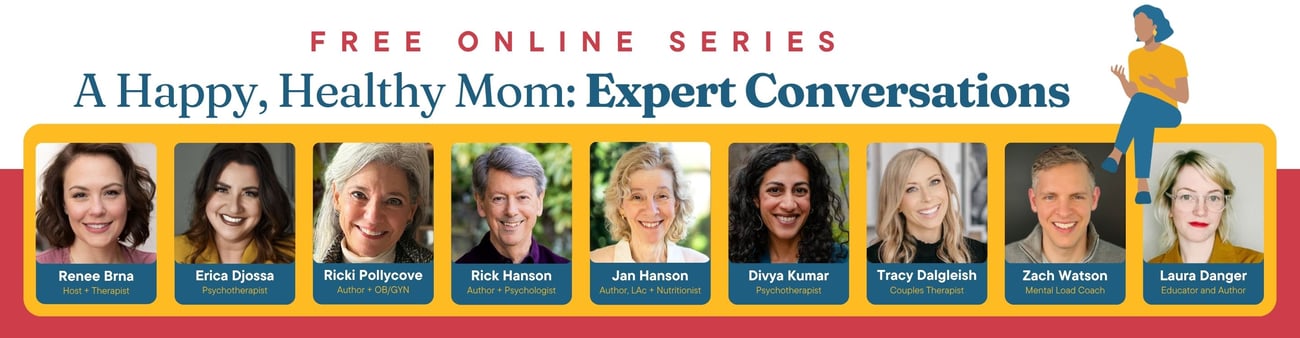
Sleepless nights, endless task lists, the weight of a household… a lot of moms constantly feel frayed — tired in a way that sleep doesn’t fix, disconnected from a partner, or quietly convinced that this exhaustion is just how it is now.
Based on the book A Happy, Healthy Mom, this series brings together clinicians, therapists, and authors who work with mothers every day, for honest conversations about what depletion actually looks like — and the practical, specific ways to get support again.
Check it out here
|
|
|
How to Use Anxiety – and Not Be Used by It!
Sometimes our anxiety is trying to tell us something important about a real threat, something we need to take care of, or someone we love. The trouble comes when anxiety keeps going long after it’s useful, turning into rumination, clinging, and worry about things we can’t control.
Last week I focused in on how to find a middle way with anxiety: listening to the useful signals without letting them take over. Listen in to learn ways to work with your anxiety: making room for unavoidable fear, finding realistic reassurance, creating a plan and taking action where you can, loosening the grip of unnecessary worry, and surrendering what is ultimately beyond your control.
Check it out here | Join the Wednesday Talks for Free
|
|
|
FROM SUBSTACK: Why Do I Feel Responsible for How Everyone Else Feels?
Speaking a little personally here. Looking back, I’ve come to realize some things about my mother’s life that I could not see when I was young. She was a young mother in the 1950s. My father was privileged in a variety of ways and she was not. She was large hearted and sweet, and she was blue. She didn’t have a lot of extended family supporting her. She did not live in the village it takes to raise a child.
And like a lot of kids who become a little parentified, I was empathic and caring, and I felt a certain influence. It was gratifying to feel like I could cheer her up, and to be her confidant sometimes as I got older.
That can lead, as an adult, to an excessive sense of your own influence. An unrealistic appraisal of your own influence over what is really happening in the minds of others.
Read more | Subscribe to My Substack
|
|
|
SCIENCE NEWS: Jupiter’s Cosmic Force Field Has More Moving Parts Than We Thought
A University of Iowa-led team has captured the most detailed look yet at Jupiter’s bow shock - the boundary where the solar wind hits the planet’s magnetic bubble - revealing a surprisingly elaborate, multi-layered system for fending off charged particles from the Sun.
(View the Science News Archive) |
|
|
FOR PARENTS: Preventing Adolescence
Before the eye rolls, slammed doors, and high-stakes choices of the teen years arrive, parents have a powerful opportunity to build the connection, resilience, and sense of purpose that can help their child thrive.
|
|
|
|
|
|
|
NOW AVAILABLE TO PURCHASE! |
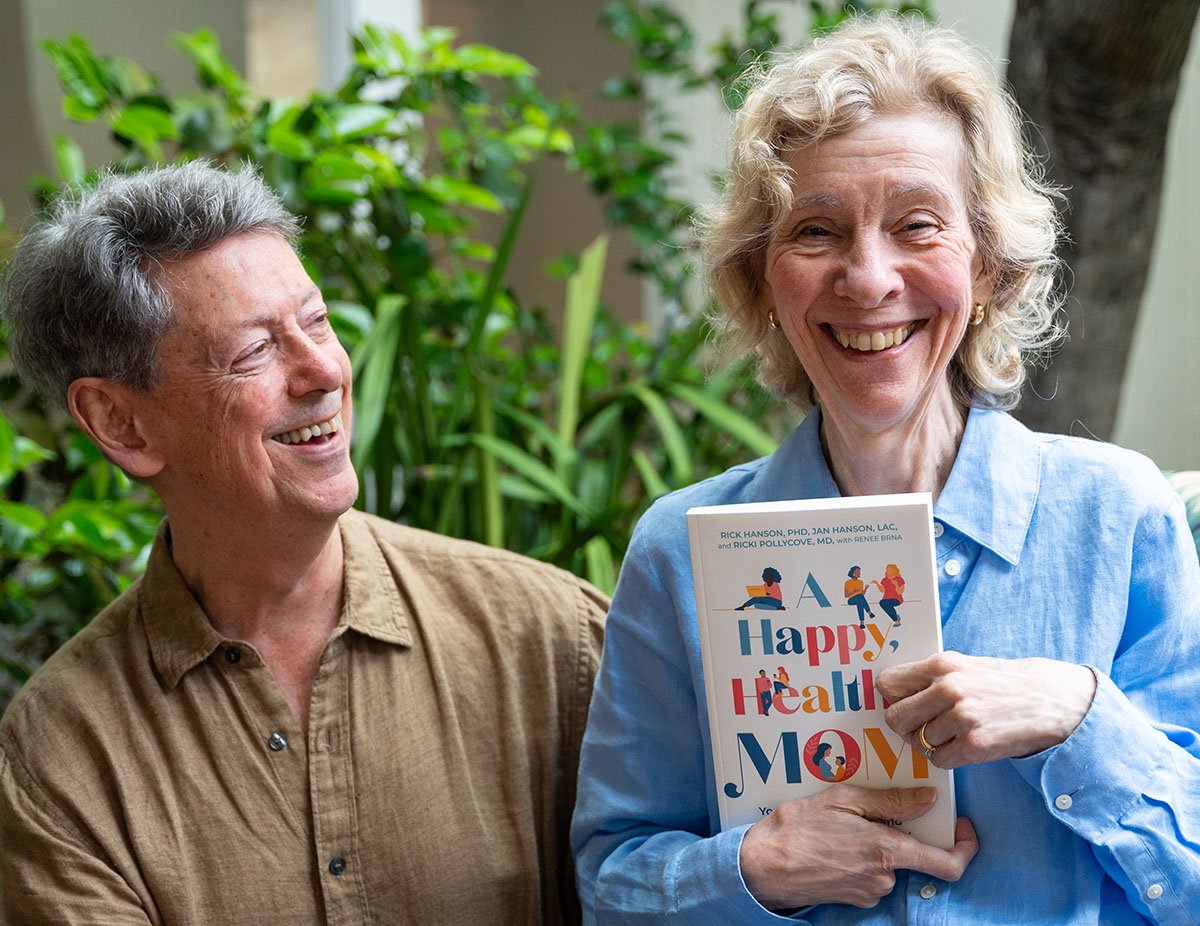
A Happy, Healthy Mom |
 |
|
We wrote this book for moms who feel exhausted, overwhelmed, or stretched too thin during the early years of raising a child. My wife Jan (a nutrition expert), friend Ricki Pollycove (a gynecologist-obstetrician), and I hope this will help moms reconnect to their own needs, restore their energy, reduce stress, and feel more supported — physically and emotionally. If you're a mom - or know one who could use some more support, I hope you'll check it out!
|
| Get Your Copy |
|
|
|
|
|
|
NEW ON THE PODCAST |
|
|
|
EPISODE 490:
Cognitive Behavioral Therapy (CBT) is the world’s most researched, recommended, and criticized form of therapy. Clinical psychologist Dr. Ellen Hendriksen joins Forrest to talk about what CBT is, its history, its strengths and weaknesses, and why it’s gotten such a bad rap. They walk through the common criticisms: that it’s spreadsheet therapy, that it’s a form of self-gaslighting, and that it has an, er, “complex” relationship with insurance companies. They then apply the best of the CBT toolkit to Ellen’s areas of expertise: self-criticism, perfectionism, procrastination, and social anxiety. |
|
> Listen Now |
|
|
|
|
JUST ONE THING (JOT) suggests a simple practice each week for more joy, more fulfilling relationships, and more peace of mind. A small thing repeated routinely adds up over time to produce big results.
Just one thing that could change your life.
(© Rick Hanson, 2026) |
|
|
|
|
|
|
|
|