
|
Step into the cloud. |
Quick note: This Saturday I'm starting a new session of my Breaking Out of Rumination course - and if you sign up by tomorrow you can save 20%.
I had a lightbulb moment recently: I was feeling stressed about all the stuff I had to do (you probably know the feeling). After this went on for a while, I stepped back and kind of watched my mind, and could see that I was thinking of these various tasks as things, like big rocks that were rolling down a hill toward me and which needed to be handled, lifted, moved, fended off, or broken into pebbles. As soon as I dealt with one thingy boulder, another one was rolling toward me. Shades of Sisyphus.
Seen as brick-like entities, no wonder these tasks felt heavy, oppressive, burdensome. Yuch!
But then I realized that in fact, the tasks I needed to do were more like clouds than things. Clouds are made up of lots of vaporous little bits, those bits come together for a time due to many swirling causes, and then they swirl away again. Meanwhile, the edge or boundary of a cloud blurs into other clouds or the sky itself. There is a kind of insubstantiality to clouds, and a softness, a yielding.
For example, take writing an email message: It has lots of little parts to it (the points you need to take into account, and the words and sentences), it is nested in a larger context – your relationship to the receiver, the needs that prompted the email – that (in a sense) calls it forth, and it emerges and passes away. This email, this task, links to other tasks, sort of blurs into them. Fundamentally, the email is a kind of process, an event, rather than a thing. It’s like you could put your hand through it.
When I considered my tasks in this way, I immediately felt better: relieved, relaxed. Tasks felt fluid, like streams or eddies I was stepping into and influencing or contributing to as best I could before they swirled on and became something else. Not so weighty or full of inertia; not so resistant, so controlling of me; not bearing down on me, but instead, something I was flowing into. Then I didn’t feel weary dealing with them. They became fun, lighter; there was more freedom in moving through them.
And it’s not just tasks that are clouds. In a way, everything is a cloud. Everything is made of parts (“compounded”), everything arises due to causes (so nothing has absolute self-existence – even “I”), and everything passes away eventually. Everything in your experience and everything “out there” in the universe is a cloud: every sensation, thought, object, body, job, career, activity, relationship, rock, raindrop, planet, galaxy, and moment.
This doesn’t mean that clouds are meaningless or that they don’t have consequences. In fact, when you relate to the world in this way, you feel more connected to it, more a part of it, more tender toward it, and more responsible for it. You love the cloud!
|
So, how do you do it? |
Start by noticing how everything is continually changing: both what’s in your inner world of thoughts and feelings and in your outer world of people, tasks, and physical stuff. Pay attention to endings and beginnings. And even if something persists, know that this is only temporary. Your own body is a cloud, continually changing.
Also, recognize how everything is made up of parts. For example, our reactions have parts (e.g., body sensations, emotions, viewpoints, wants), kitchen tables have parts, relationships have parts (e.g., history, aspects in different situations), and tasks have parts.
Appreciate how these changing parts arise and pass away due to many causes. Everything really is an eddy in the river of reality, emerging and changing and ending because of 10,000 causes upstream.
Try to feel these facts – impermanence, compoundedness, interdependence: the fundamental cloudiness of everything – intuitively, emotionally, and in your body, not just conceptualize them with your mind.
Then consider a task or situation that weighs on you in this light. Reflect on its many parts, on some of the causes that brought it into being, and on its inherent transience (even if it’s painfully long transience!). Try to see it more as a cloud than a brick.
Notice how your mind tries to turn clouds into bricks. To help us survive, the brain continually tries to make fluid processes (hard for lizards, mice, and monkeys to deal with) appear to be static entities (much more manageable). It does this through forming labels, categories, and concepts – and through presuming that everything is a thing-in-itself rather than only passing frothy foam on a transient wave in our ocean of a universe.
Enjoy the clouds. Relax. Flow into the clouds of your responsibilities, relationships, and roles. A cloud yourself, flow into them, through them, beyond them.
|
| Read This Online
|
Share on Facebook | Forward this Email
|
|
|
|
|
|
MORE GOOD STUFF
|

|
Feeling overwhelmed by life or the state of the world? You’re not alone. So many of us are carrying more stress, uncertainty, and mental load right now, and it can be hard to stay grounded, steady, and strong through it all. That’s why I'm joining the folks at Mindfulness.com for The Seven Strengths: a free live 7-day course to help you build the inner skills that support lasting resilience, peace, and mental wellbeing.
Check it out here
|
|
|
Keys to Personal and Global Evolution with David Sloan Wilson
It’s easy to feel stuck in the same patterns—repeating old reactions, circling in the same thoughts, and wondering why real change is so hard. So last week, David Sloan Wilson and I explored how Darwin’s insights into evolution can be applied to your own healing, growing, and awakening.
Check it out here | Join the Wednesday Talks for Free
|
|
|
SCIENCE NEWS: Your Brain After Stress
New findings suggest that the brain may enter a surprisingly important window for recovery and growth about an hour after stress — highlighting how resilience is not just about enduring difficulty, but also about what happens afterward.
(View the Science News Archive)
|
|
|
FOR PARENTS: 10 Reasons to Take Good Care of a Mother
This Mother’s Day, it’s worth remembering that when mothers are cared for, supported, and nourished themselves, everyone around them benefits — especially the people they love most.
|
|
|
|
|
|
NEW ON THE PODCAST
|
Using Constraints to Improve Creativity, Focus, and Decision-Making with David Epstein |
EPISODE 471:
Forrest is joined by best-selling author David Epstein to discuss how constraints can lead to greater creativity, generativity, and, paradoxically, freedom.
|
> Listen Now
|
|
|
|
|
|
NEW BOOK AVAILABLE FOR PREORDER
|
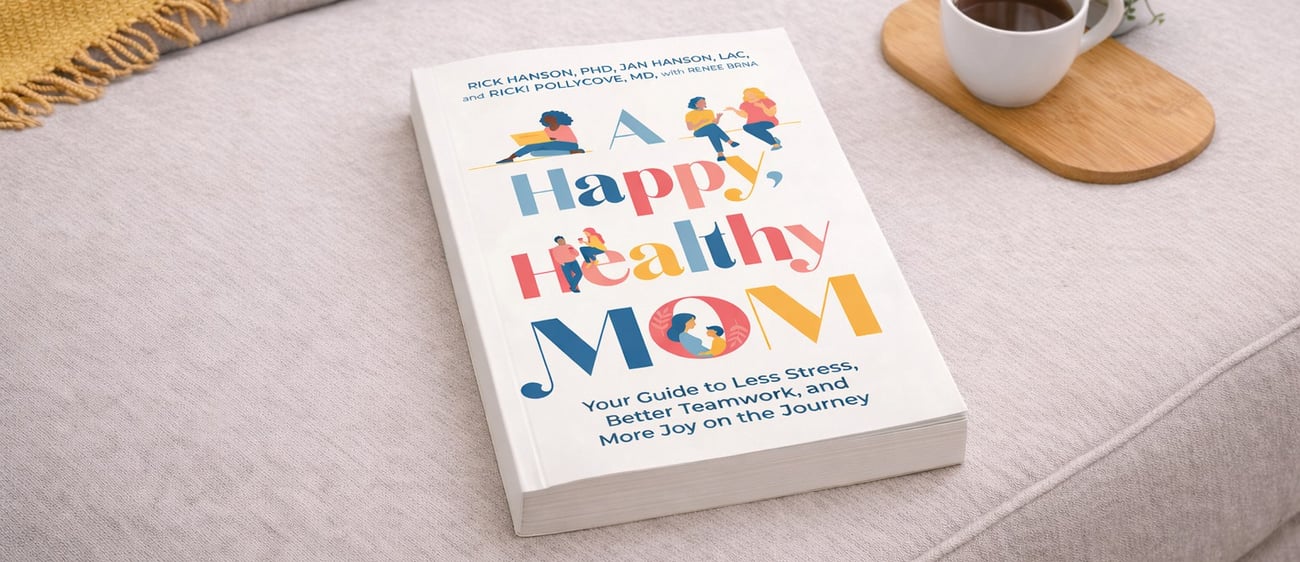
A Happy, Healthy Mom |
|
We wrote this book for moms who feel exhausted, overwhelmed, or stretched too thin during the early years of raising a child. My wife Jan (a nutrition expert), friend Ricki Pollycove (a gynecologist-obstetrician), and I hope this will help moms reconnect to their own needs, restore their energy, reduce stress, and feel more supported — physically and emotionally. If you're a mom - or know one who could use some more support, I hope you'll check it out!
|
| Preorder Your Copy
|
|
|
|
JUST ONE THING (JOT) suggests a simple practice each week for more joy, more fulfilling relationships, and more peace of mind. A small thing repeated routinely adds up over time to produce big results.
Just one thing that could change your life.
(© Rick Hanson, 2026)
|
|
|
|
|
|
|
|
|


